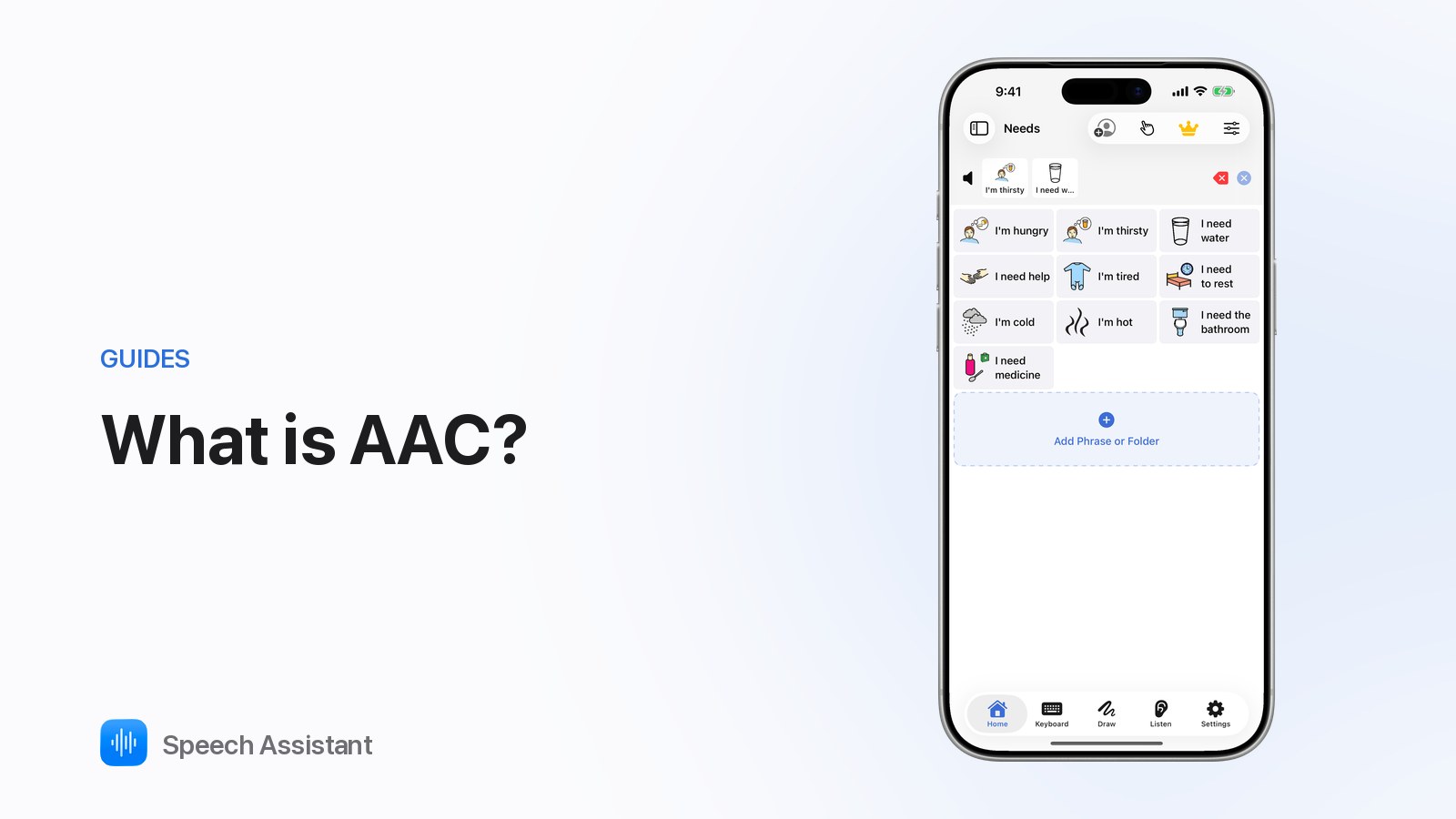
AAC (augmentative and alternative communication) is any way of communicating that adds to speech or replaces it: gestures, picture boards, letter boards, or a device that speaks.
Who uses AAC?
Anyone whose speech doesn't meet all their needs, for a short time or for life. For example:
Autistic children and adults, including people who speak some of the time
Children with apraxia, Down syndrome or cerebral palsy
Adults with aphasia after a stroke, or with ALS/MND
People recovering from surgery or on a ventilator
What types of AAC are there?
No-tech: gestures, signs, facial expressions, pointing.Low-tech: paper picture boards, letter boards, a pen and paper.High-tech: devices and apps that speak out loud when you tap a picture or type.
Most people use a mix. A paper board in the bath, an app on the go, gestures all day.
What are the common myths?
"AAC is a last resort." It works best started early, alongside speech therapy."They have to be ready first." There are no prerequisites. People learn AAC by seeing it used."It stops them from talking." Research has consistently found it does not, and often helps."It's only for people who can't speak at all." Many AAC users speak some words and use AAC for the rest.
How do families get started?
Talk to a speech-language therapist. They can assess and suggest a system.Model it. Tap or point to words yourself while you talk. No pressure to copy.Keep it close. AAC only helps if it is there when the person wants to say something.Start small. A few motivating words plus core words like more , stop and help .
Where does Speech Assistant fit?
Speech Assistant is a free high-tech AAC app for iPhone, iPad and Apple Watch:
Tap Continue as Guest and starter boards are ready: Core Words, Greetings, Needs, Food & Drink, Feelings, Questions.
Tap a picture tile and it speaks; build a sentence and play it.
A keyboard for people who can spell.
Speech uses on-device voices, so tapping and typing work offline.
Next: your first week of AAC and core words to start with .
Questions people ask What does AAC stand for? Augmentative and alternative communication: ways to add to speech (augmentative) or replace it (alternative).
Does a person have to be a certain age or level to use AAC? No. There are no prerequisites. Toddlers, teenagers and adults all use AAC, and a speech-language therapist can help choose a starting point.
Will AAC stop speech from developing? Research has consistently found that AAC does not hold back speech, and it often supports it.
Is an app a real AAC system? Yes. A speaking app on a phone or tablet is high-tech AAC, the same category as a dedicated speech device.
Speech Assistant - AAC Pad
Free AAC for iPhone, iPad and Apple Watch.